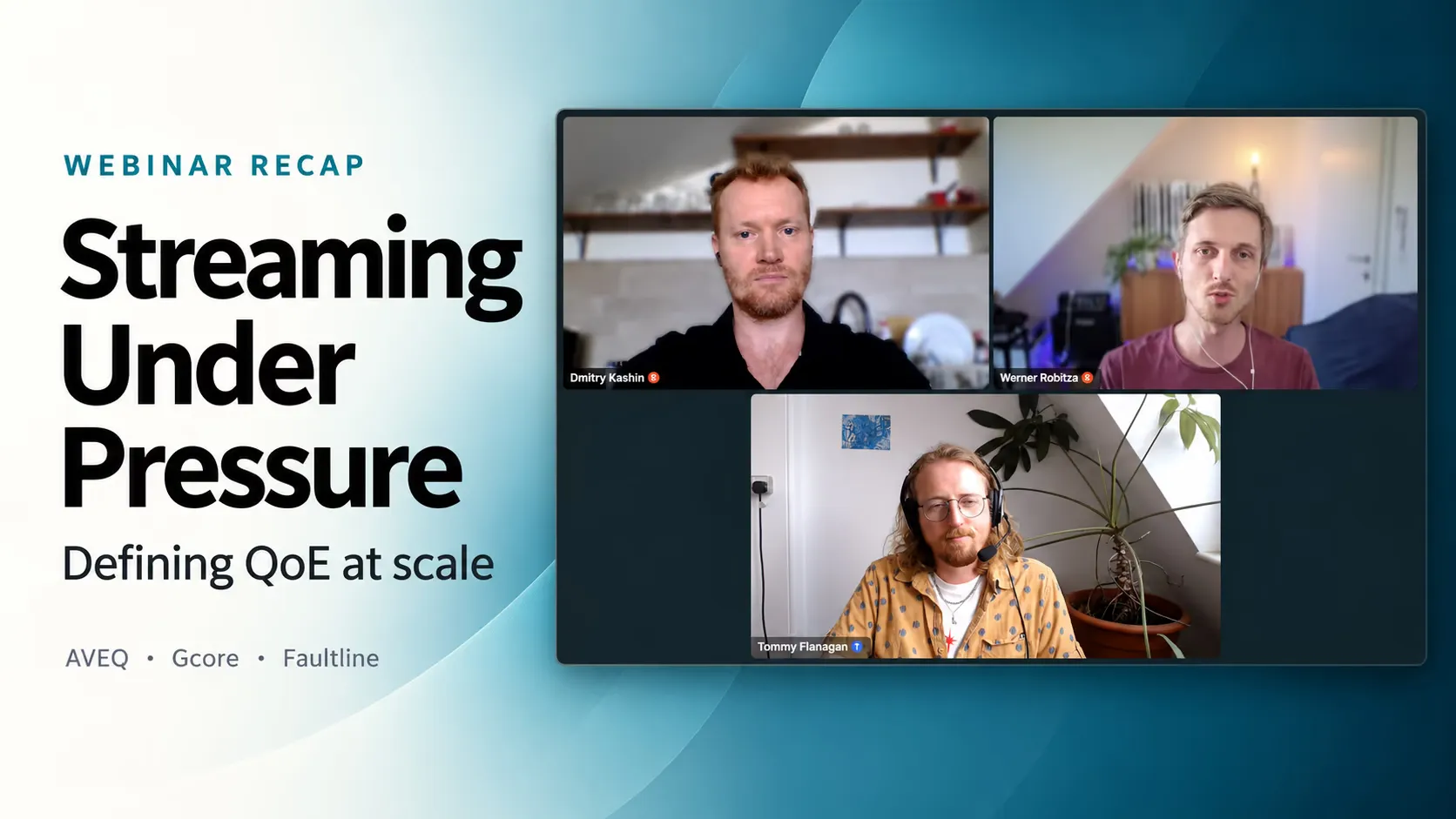
On September 1, our co-founder and CEO Werner Robitza joined Dmitry Kashin, lead streaming architect at Gcore, for a live Faultline webinar hosted by editor Tommy Flanagan: “Streaming Under Pressure: How Do We Even Define QoE at Scale Anymore?” It was an hour of discussing what QoE means, weighting trade-offs, and talking about whether perfect streaming was still a wish list or already a reality. Here’s the recap.
Even the experts have bad streaming days
Tommy opened with an icebreaker: when did each panelist last have a genuinely bad streaming experience? Werner’s answer came quick: after switching ISPs in Vienna, he still has 500 Mbit/s of capacity, but peering and caching issues mean his kids now regularly complain that “YouTube’s not working.” Which is ironic, given his background, but there’s not much a user can do at this point. Dmitry pointed to mobile network reliability while traveling. Tommy blamed a very pixelated Premier League match on Now TV.
The point set up the theme for the whole session: bandwidth alone doesn’t guarantee a good experience, and there’s still no single scoreboard everyone agrees on. Werner noted that expectations keep climbing even as stalling has become rare in absolute terms. This is because as technology gets better, people become used to the new standard, and that keeps raising the bar. So, even though adaptive streaming has been around for more than a decade, we’re still continuing to improve it. Also, Werner noted the recency effect — one bad session can erase years of good ones and drive churn.
Tommy then also created a poll, asking whether we had too many QoE metrics, or too few. It turns out the industry has too many to tell what the real quality is, but Werner also pointed out that it depends on what your focus is: as a CDN engineer, you want network-related metrics. For the headend, you need proper perceptual video metrics. And for the end user, engagement-related QoE metrics like stalling, startup time, exits before video start, etc., matter more than anything else.
What the 2026 World Cup taught us
The panel spent the most time on the World Cup, widely reported as the most-streamed edition ever with surprisingly few public complaints about quality. Werner and Dmitry both pushed back on the idea that this happened by accident.
In AVEQ’s independent measurements, one OTT provider switched from a single CDN to a multi-CDN setup shortly before the tournament, expecting more headroom. However, quality got worse instead — more stalling, more quality switches — even before World Cup traffic arrived. The provider reverted to a single CDN once the tournament ended, and quality went back to normal. Multi-CDN isn’t automatically better. It has to be measured and tuned, as it’s a complex system with lots of moving parts.
On the delivery side, Dmitry described weeks of capacity planning, route and interconnect checks, and origin protection to avoid request storms. One surprise stood out: a burst of legacy DASH traffic from older smart TVs looked alarming in the shield-server logs. However, proper caching and load balancing meant it never actually threatened the origin. In fact, Werner remarked how well Gcore was prepared, as the engineers weren’t breaking a sweat even during the busiest times.
AVEQ also showcased how they ran independent, active measurements for German broadcaster WDR across three CDNs throughout the tournament, tracking stalling, startup time, and quality switches. The data showed real differences between CDNs. In one match, four of five measurement probes stalled simultaneously on a single CDN, for up to 4.8 seconds. But that was the worst example: otherwise, everything was mostly fine. There was no major outage across the whole event. Dmitry summed up AVEQ’s role: “This is where AVEQ shines: it provides us with useful metrics that we can also give to our clients.”
Latency is social, quality is perceptual
Werner and Tommy then discussed the quality vs. latency trade-off. Werner pointed out that quality problems are perceptual, but latency problems are social. You only notice you’re behind when a neighbor cheering before your stream shows it. That distinction shaped a lot of the World Cup’s technical decisions. Gcore’s multi-CDN setup for the tournament used a “lower-latency” but not Low-Latency configuration: two-second segments over HLS, with a four-second target edge delay, plus additional sub-second prefetching that Gcore implemented. That favored stability under real network conditions over chasing the absolute lowest latency possible.
The group acknowledged that latency vs. quality is a decision made upfront, and that it’s hard to change a system once set up, especially when everyone’s personal preferences are different. But Werner also pointed to playback elasticity as a possible mitigation: quietly speeding up or slowing down playback to catch up, instead of stalling outright. Research, including work from the BBC, shows viewers prefer this to a hard rebuffer.
A green dashboard, an unhappy viewer
A joint AVEQ/Gcore investigation looked at a World Cup match where every network-side metric looked healthy: request times under a second, status codes mostly 200s, low TCP retransmission. Yet AVEQ’s player-side, end-to-end measurements showed real stalling events for viewers.
The gap comes from how you observe the different layers. CDN-side network metrics and player-side adaptive-bitrate behavior are two different views of the same delivery chain, and a problem can hide between them: an imperfect ABR implementation, a stale manifest, insufficient sub-second caching. Nobody’s dashboard was lying, per se. They just weren’t measuring the same thing.
Therefore, combining CDN-side traces with independent, end-to-end QoE measurement can detect what either side would miss.
Looking ahead
Tommy closed with a five-year wish list. How should streaming look like in a few years from now?
Werner would happily never see interlaced video again, and expects more personalized, context-aware streaming, where the trade-off between latency and quality adapts to what you’re actually doing rather than one fixed configuration for everyone. Dmitry wants real unification: QoE signals feeding back automatically into encoders and CDN behavior, with AI helping detect and react to anomalies closer to real time.
Both agreed on the harder answer to the headline question: there’s no single metric that captures QoE at scale, and there probably shouldn’t be. CDN engineers, broadcasters, and viewers each need a different slice of the picture.
Thanks to Tommy, Dmitry, and everyone at Faultline and Gcore for a great discussion, and to everyone who joined live with questions. If you missed it, the full replay is available here.