ITU-T P.1203 and P.1204 Video Quality Models
Standards-based video quality measurement and session-level QoE for OTT services.
AVEQ applies ITU-T P.1204 for modern short-term video quality measurement and ITU-T P.1203 for session-level QoE that includes audio, startup delay, stalling, and quality variation.
Overview
Complementary ITU-T standards for video quality measurement
AVEQ uses both standards as part of one standards-based approach to video quality measurement. ITU-T P.1204 addresses short-term video quality, while ITU-T P.1203 provides the session-level QoE framework for adaptive streaming.
This distinction matters for operators, OTT providers, app teams, and benchmarking programs. P.1204 supports analysis of delivered video quality at the segment level. P.1203 combines quality and playback behavior into a final MOS for the full viewing session.
At a glance
What each standard contributes to the measurement stack
P.1204
Short-term video quality models for modern OTT delivery, including lightweight no-reference measurement for current codecs and resolutions.
P.1203
Session-level QoE framework that combines video quality, audio quality, startup delay, stalling, and quality variation into one overall MOS.
The combination matters
Short-term video quality measurement and session-level QoE fit into one standards-based approach to video monitoring and reporting.
ITU-T P.1204 at a glance
- Standardized short-term video quality, typically on segments of roughly 5-10 seconds
- Designed for modern codec and 4K-era delivery scenarios
- P.1204.1 supports lightweight metadata-based, no-reference measurement
- Built for OTT, mobile, benchmarking, and other deployments where source-reference workflows are impractical
ITU-T P.1203 at a glance
- Standardized session-level QoE for adaptive streaming
- Integrates video quality, audio quality, startup delay, stalling, and quality variation
- Produces one final MOS for the viewing session
- Used for reporting, benchmarking, and operational quality decisions

Modern video quality
Standardized short-term video quality for modern OTT services
Modern OTT services rarely expose source assets for reference-based analysis. Encryption, third-party delivery, and broad variation across devices, codecs, and resolutions make lightweight standards-based measurement essential.
P.1204.1 is a metadata-based no-reference model within the ITU-T P.1204 family. It estimates video quality from bitrate, resolution, frame rate, and codec without requiring the original video.
At AVEQ, this standards-based video-quality layer is implemented in solutions such as the ITU Video MOS Plugin and supports the codec and resolution coverage that OTT operators, benchmarking providers, and app teams expect today.
Session QoE
Session-level MOS from video quality and playback behavior
ITU-T P.1203 remains important because it integrates video quality with audio quality, startup delay, stalling, and quality variation over time into one final session-level MOS.
For service benchmarking, product reporting, and operational monitoring, a final session score is often more useful than isolated short-term segment scores.
In AVEQ products, P.1203 is the integration layer that turns technical measurements into one session-level QoE result that can be used for benchmarking, reporting, and product decisions.
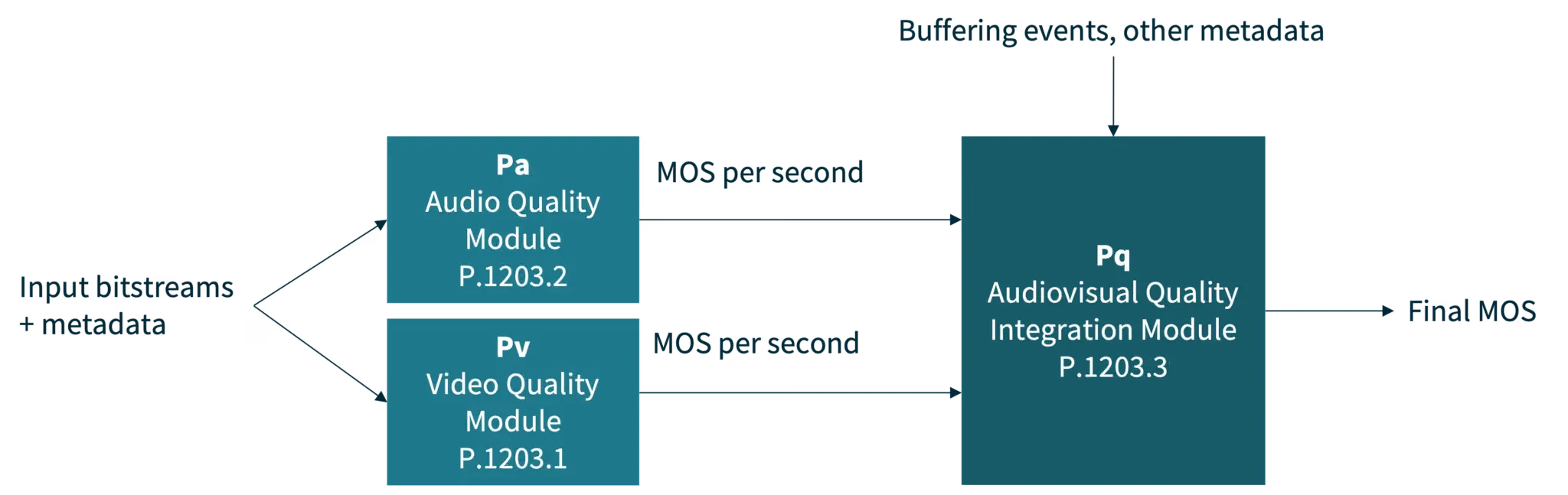
P.1203 integrates short-term quality and playback context into one session-level MOS.
Architecture
Two standards across one measurement stack
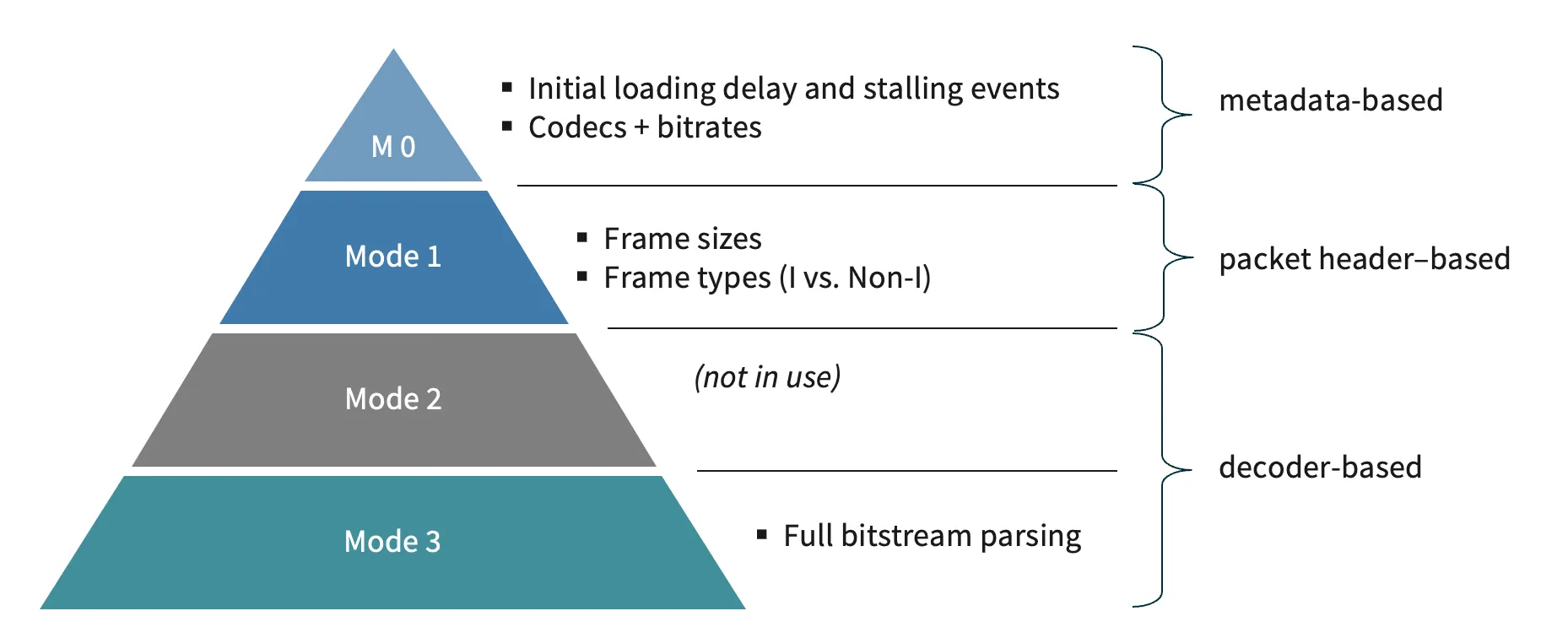
P.1203 and P.1204 serve different layers of the same measurement stack. P.1203 includes multiple modes that balance depth and deployability. P.1204 covers the short-term video layer, from metadata-based P.1204.1 to deeper bitstream-based options such as P.1204.3.
AVEQ applies these standards across automated measurement and integration products, including Surfmeter Automator and the ITU Video MOS Plugin . Measurement and reporting remain aligned to the same standards from test execution through QoE reporting.
Validation
Public documentation and validation
P.1203 and P.1204 are public ITU-T standards with documented methods, scopes, and outputs. This gives operators, OTT providers, and technology partners a transparent basis for quality measurement.
The official ITU-T recommendation pages for P.1203 and P.1204 provide the formal reference points for verification.
AVEQ applies these standards in commercial products, from standards-based MOS integration to automated measurement with Surfmeter Automator . Customers can use these standards-based metrics for monitoring, benchmarking, and service-quality reporting.
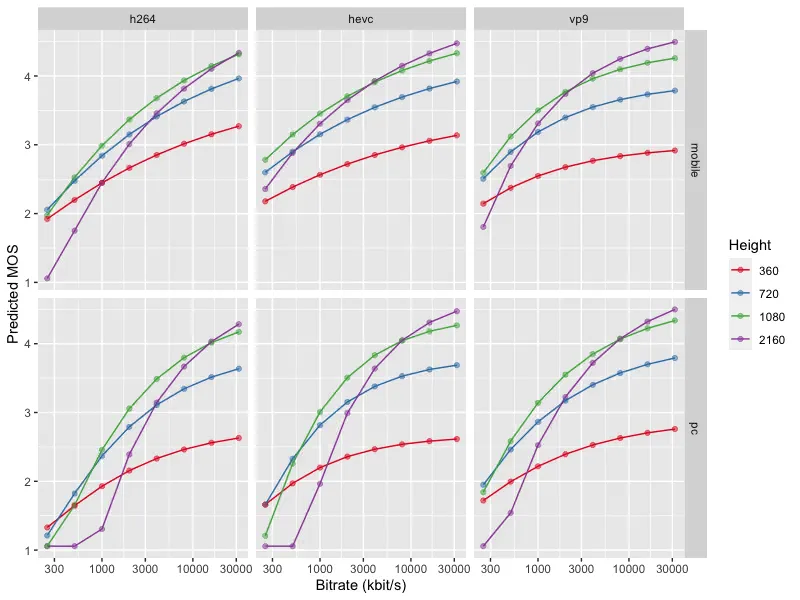
P.1204 strengthens short-term video quality estimation for newer codecs, higher resolutions, and realistic OTT delivery conditions.
Data & KPIs
How P.1203 and P.1204 map to inputs, measurement layers, and outputs
Typical inputs
- Average Video BitrateAverage data rate of video stream
- ResolutionVideo output resolution
- Frame RateFrames rendered per second
- CodecVideo compression format
- Initial Loading DelayTime until video starts playing
- Stalling EventsNumber and duration of stalling
Short-term video quality layer
- P.1204 NR MOSNo-reference quality score (1–5)
- Video Quality (Pv)Visual quality sub-score (1–5)
- Per-Segment ScoresQuality scores per video segment
- Temporal Quality VariationQuality fluctuation over time
Session-level integration layer
- Audio Quality (Pa)Audio quality sub-score (1–5)
- P.1203 Overall MOS (Pq)Combined audio-visual quality (1–5)
- Playback State TimelinePlay, pause, and buffer events over time
- Resolution & Quality SwitchesHow often quality changes mid-stream
Next steps
Documentation and AVEQ implementation


Bring standards-based video QoE into your service
AVEQ helps OTT providers, operators, and technology partners apply P.1203 and P.1204 in monitoring, benchmarking, and service-quality reporting.
Thank you! We'll get back to you shortly.
Something went wrong. Please try again.