Should MOS be the next relevant criterion for an RFQ?
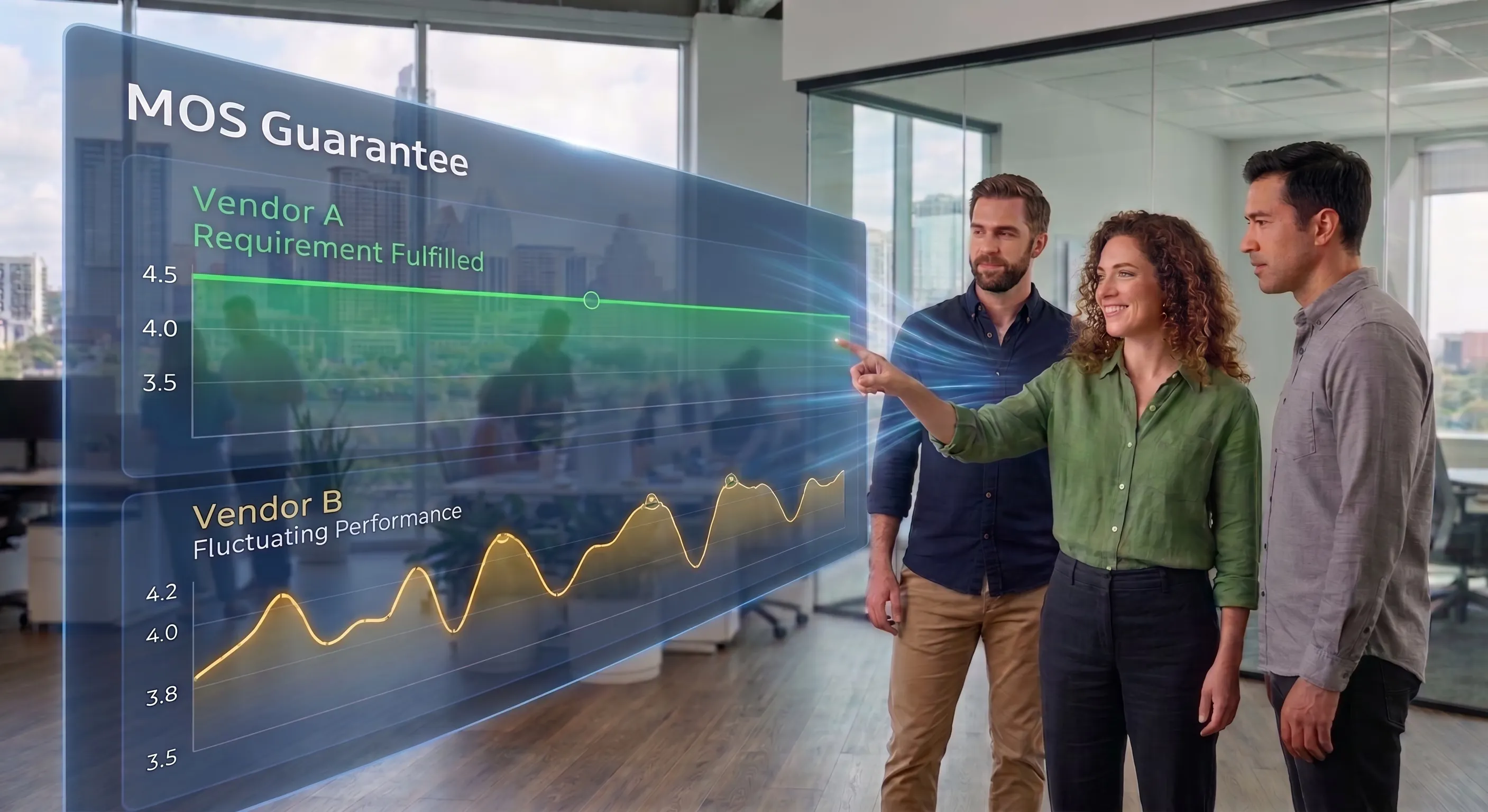
In autumn ‘24, we first heard this idea during a meeting with a prospect. One year later, at IBC25, we heard people discussing it again: putting a requirement into an RFQ that a specific player technology or CDN must guarantee a Mean Opinion Score of at least xyz.
Wow! Even we, who talk about MOS nearly every day, hadn’t thought of that yet. But we can understand why the industry is considering it. Today’s streaming demands are becoming more challenging, and quality can break at points beyond the user’s Wi-Fi and the camera operator. A vendor guarantee claiming that the issuing platform will never suffer a certain drop in quality when using a specific solution may indeed make sense for buyers to consider.
So yes, we definitely welcome quality gaining more weight in future buying decisions. Meanwhile, we — the QoE guys — are wondering: how can such guarantees be achieved? Networks have complex structures, and failures can happen at any time. Even when you measure MOS from one endpoint of a CDN, it might be totally different at another access point.
Bringing the MOS into the center of a buyer’s decision requires a clear understanding of the following:
What buyers need to know beforehand
Let’s start at the beginning. Buyers seeking the best value for their platform need to select a technology (player, set-top box, CDN, …) that will never diminish the overall experience, but at least maintain or, preferably, improve it. But how can they make sure?
Today, we know of two different approaches to determining a platform’s quality:
While the first idea seems straightforward, users may not want to fill out surveys, and platforms will usually receive only sample data. We know broadcasters who try to collect more quality ratings by paying thousands of users each month to watch streams continuously and report bugs. It is an expensive approach, and we are happy not to be part of the support team that has to evaluate this flood of human-reported tickets each month: 50% describe more or less the same problem, 45% describe issues unrelated to the platform itself, and the small remainder come from picky users who see a drop in quality even in a misspelled movie title. 😉
We therefore prefer the second option, as it can aggregate our users’ experiences into a single number—something that is easy to grasp, doesn’t bother the user, and doesn’t produce substantial financial or organizational overhead. MOS can easily achieve this.
Recommendation No. 1
Use Standards — MOS ≠ MOS
So, would it suffice for buyers to simply require a minimum MOS of xyz in their RFQ?
The caveat is that the term “MOS” is sometimes used in confusing contexts, while companies may introduce their own measures of what they claim to be “good quality.”
We have seen various examples: so-called “Happiness Scores,” direct uses of the term “QoE,” and simple promises such as “high-quality streaming” or “perfect streaming quality.” While each might make sense for an individual use case, it feels like walking through a supermarket where every product claims to be organic and fair trade. Without standardization, customers can get lost in a jungle of claims and seals. The last thing a streaming platform wants is to realize that it bought the wrong solution after spending a large budget on vague promises. Standards help here.
The International Telecommunication Union (ITU) developed the ITU-T P.1203 standard to address this issue. It was the one and only standard that could predict user ratings with the highest accuracy by capturing what happens during video playback itself on a scale from 1 to 5. “It was” because, in December 2025, the ITU published its successor, ITU-T P.1204. We at AVEQ are happy to see its release, as it brings a range of updates to the existing P.1203 standard. We have had excellent experiences with these standards in recent years. They are used in nationwide streaming benchmarks.
In 2025, we helped a broadcasting provider resolve a common streaming issue related to player configuration and CDN caching simply by optimizing these factors. Engineers we have worked with often tell us that, since they began using this single aggregated number, they no longer fly blind: they can immediately see the impact of each architectural decision. And the great thing is that not only can they see it, but their users notice it too. So, when you as a buyer want a MOS guarantee from your vendor, ask for a standardized one. It will help both of you the most!
Recommendation No. 2
Know How to Validate the RFQ Promise
Now that we know there are multiple ways for a vendor to guarantee “good streaming quality,” the question is: how can you validate whether the promise is being kept?
This part is relevant to both vendors and buyers. Buyers want reports showing that everything works well, while vendors want to know what they can do to keep their promise. When you choose automated MOS validation, there are two ways to verify it:
Set up automated probes at strategic locations that sample your channels each day and check in constantly like a real user to measure what is happening during playback.
Integrate a validation tool directly into your platform to continuously monitor the quality of every session (or selected sessions) directly from users' home screens.
Passive monitoring is great if you want the full picture. Active monitoring is ideal if you want a cost-effective solution that can already provide strong indications of the user experience without large rollouts. Active monitoring also gives your technicians additional flexibility to test new, unreleased features before they reach production (and avoid unintentionally degrading quality).
At AVEQ, we support both approaches to quality monitoring. Both solutions provide Mean Opinion Scores based on the latest standards, as well as the data technicians need to understand why a MOS guarantee could not be met and how to restore the required quality.
We know buyers who use MOS-related monitoring solutions before selecting a vendor in order to determine which one delivers the best quality. What matters is not only whether the desired quality can be achieved on average, but also how consistent it is—that is, how much it varies between good and bad. If you step into water that people tell you is 20 cm deep on average, there could still be a 2 m hole somewhere in the middle. These are the kinds of outliers buyers want to avoid when choosing the right solution.
What we recommend
So, when buyers want MOS guarantees, we recommend that they determine which MOS is to be guaranteed. As this idea is still evolving and not everyone is aware of it yet, we also recommend considering a requirement to maintain “good quality” and asking the vendor to explain how it verifies that quality. When you see a standard such as P.1203 or P.1204 mentioned, make sure the vendor is using the latest technology currently available to validate its solution.
If you are a vendor, ask how the buyer validates your solution. We met a vendor that lost an RFQ because it did not even know it was being evaluated—and ultimately lost because of a few decimal places!
In any case, if you want to know more about how RFQ guarantees can be verified or how the P.1203/P.1204 standards work, are looking for a suitable solution, or need help fixing your quality problems reliably, we are here to help.
Drop by for a demo, and feel free to contact us at the upcoming IBC!
Next Steps
Ready to Validate Your MOS Guarantees?
Check out our products designed for automated quality monitoring and in-depth player analytics: